Respuesta directa: pista versus pista E
La principal diferencia es la forma y función de la ranura. El riel estándar, a veces llamado riel logístico o riel en L, utiliza una serie de orificios redondos u ovalados espaciados a lo largo de un canal recto, y los accesorios de anclaje caen en un orificio y se giran para bloquear. Rieles de vía electrónica en su lugar, utilice un canal ranurado continuo con un labio elevado a lo largo de ambos bordes, lo que permite que un accesorio con resorte se deslice en cualquier lugar a lo largo del riel y se sujete en cualquier punto en lugar de solo a intervalos de orificios fijos.
Esta elección de diseño cambia casi todo acerca de cómo se utiliza cada sistema en la práctica. Rieles de vía electrónica Brinda a los instaladores libertad de posicionamiento continua a lo largo de toda la longitud del riel, mientras que el riel estándar limita la colocación del accesorio a ubicaciones de orificios previamente perforados, generalmente espaciados cada 2 pulgadas (unos 5 cm) . Para asegurar la carga en camiones, remolques y furgonetas, esta diferencia determina con qué precisión se puede anclar una carga y con qué rapidez se pueden reposicionar las correas.
Cómo se construye físicamente cada sistema ferroviario
Comprender la construcción física de cada tipo de riel explica por qué la compatibilidad de los accesorios y las capacidades de carga difieren tan significativamente entre los dos sistemas.
Diseño de vía estándar
El riel estándar es un canal de acero o aluminio plano o ligeramente empotrado con orificios perforados a lo largo de toda su longitud. Los accesorios suelen ser anclajes estilo barra que caen en un orificio y luego giran 90 grados para bloquearse debajo del borde del riel.
Diseño de riel electrónico
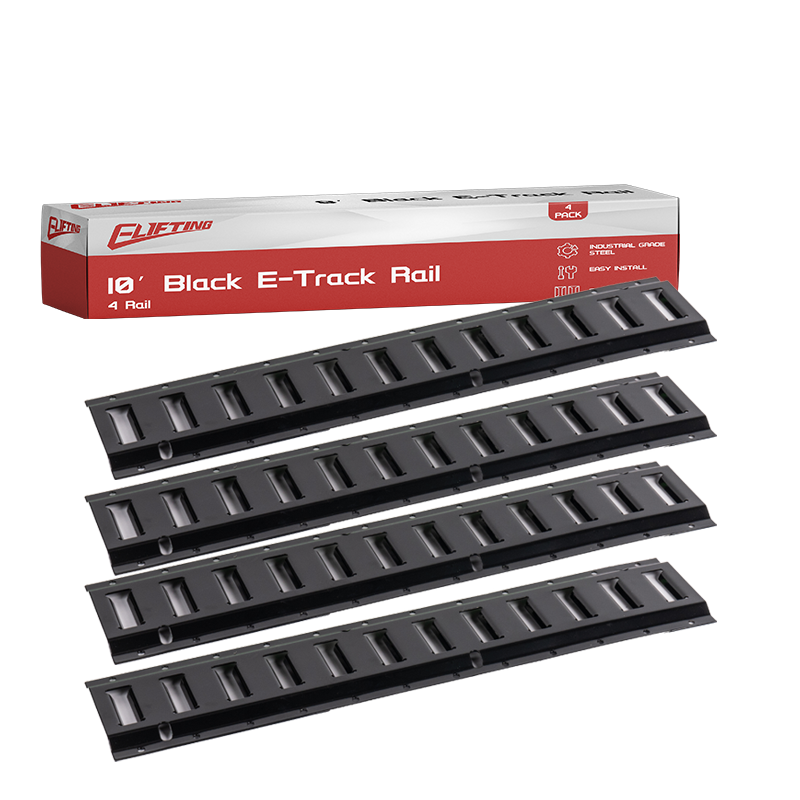
Los rieles E-track cuentan con una ranura continua bordeada por un labio curvado hacia adentro en cada lado, formando una forma que se asemeja a la letra E cuando se ve en sección transversal. Los accesorios, como los accesorios en E con resorte o las juntas tóricas, se insertan en la ranura y se pueden colocar en cualquier lugar a lo largo del riel antes de bloquearse en su lugar bajo tensión.
Diferencias de materiales y calibres
Ambos sistemas se fabrican comúnmente con acero galvanizado o aluminio, con rieles de acero generalmente clasificados para cargas de trabajo más altas y rieles de aluminio preferidos cuando la reducción del peso del vehículo es más importante que la capacidad máxima.
Comparación lado a lado de especificaciones clave
La siguiente tabla resume las diferencias prácticas que los compradores comparan con mayor frecuencia antes de elegir entre los dos sistemas.
| Característica | Pista estándar | Rieles de vía electrónica |
| Espaciado de puntos de anclaje | Fijo, cada 2 pulgadas | Continuo, cualquier posición |
| Carga de trabajo típica por accesorio | Hasta 2000 libras | Hasta 2000 - 2500 libras |
| Orientación de montaje común | Piso o pared | Postes de piso, pared o verticales |
| Método de instalación de accesorios | Caer y girar en el agujero | Desliza y bloquea bajo tensión del resorte. |
Comparación de especificaciones generales entre rieles de carga estándar y rieles E-Track
- Los accesorios se pueden colocar en cualquier punto a lo largo del riel, lo cual es fundamental a la hora de asegurar cargas de tamaño o forma irregular.
- El diseño ranurado permite la instalación de rieles tanto horizontales como verticales, lo que permite asegurar la carga multidireccional en el mismo vehículo.
- Existe una amplia gama de accesorios compatibles, incluidos accesorios E, juntas tóricas, juntas en D y barras de carga, lo que amplía la versatilidad para diferentes tipos de carga.
- La ranura continua resiste mejor la acumulación de residuos que los agujeros perforados, que pueden atrapar la suciedad y la humedad con el tiempo.
Cuando la pista estándar todavía tiene sentido
El riel estándar sigue siendo una opción práctica en escenarios específicos, particularmente cuando el espacio entre anclajes fijos no es una limitación.
Cargas de carga uniformes y repetidas
Las flotas que transportan repetidamente los mismos tamaños de paletas o dimensiones de cajas se benefician menos del posicionamiento continuo, ya que el mismo espacio fijo entre orificios funciona de manera confiable carga tras carga.
Requisitos de costo inicial más bajo
Las vías estándar y sus accesorios suelen ser menos costosas por pie lineal que los sistemas E-track, lo que las convierte en una opción razonable para construcciones que cuidan su presupuesto y tienen perfiles de carga predecibles.
Cómo decidir qué sistema se adapta a su aplicación
La elección entre rieles estándar y rieles E-Track debe basarse en la variabilidad de carga real y las necesidades de montaje del vehículo o remolque que se está equipando.
- Identificar cuán variadas son las formas y tamaños de la carga; La variación frecuente favorece el posicionamiento continuo de los rieles E-track.
- Determine si es necesario el montaje vertical en la pared, ya que los rieles E-track suelen estar clasificados y configurados para instalación vertical.
- Confirme el límite de carga de trabajo requerido para la carga más pesada esperada y compárelo con la clasificación del accesorio y del riel.
- Verifique la compatibilidad de los accesorios disponibles, ya que los sistemas E-track generalmente admiten una gama más amplia de accesorios y barras de carga.
- Tenga en cuenta la mano de obra de instalación, ya que los rieles E-track generalmente requieren menos puntos de montaje perforados con precisión a lo largo de toda la longitud del riel.
Consideraciones de instalación y clasificación de carga
Independientemente del sistema de rieles que se seleccione, la instalación adecuada afecta directamente la carga de trabajo real que el sistema puede soportar de manera segura.
- Monte los rieles en miembros de la estructura estructural en lugar de paneles delgados siempre que sea posible, ya que el riel en sí es tan fuerte como su superficie de montaje.
- Utilice sujetadores clasificados para las fuerzas cortantes y de extracción esperadas, generalmente pernos de grado 5 o mejores para instalaciones de rieles de acero.
- Separe los sujetadores de montaje según el intervalo recomendado por el fabricante, generalmente cada 12 a 16 pulgadas a lo largo de la longitud del carril.
- Inspeccione los accesorios periódicamente para detectar fatiga o deformación del resorte, ya que un accesorio desgastado puede deslizarse bajo carga incluso cuando el riel en sí no está dañado.
Adquisición de rieles E-Track de calidad para su flota
Debido a que la resistencia del riel depende en gran medida del calibre del material, la calidad del recubrimiento y las tolerancias de fabricación, contratar a un proveedor que documente las clasificaciones de carga y las especificaciones de los materiales ayuda a evitar discrepancias entre el rendimiento anunciado y el real. Los administradores de flotas y proveedores de vehículos que comparan opciones a menudo revisan especificaciones detalladas, como las que figuran en la Rieles de vía electrónica product page , para confirmar el calibre del riel, el acabado y los tipos de accesorios compatibles antes de realizar un pedido. La tolerancia de fabricación constante en todo el ancho de la ranura es lo que en última instancia determina si los accesorios se bloquean de forma segura sin juego excesivo. , por lo que solicitar datos de prueba dimensional es un paso razonable para cualquier compra al por mayor.